Wartime rationing system in Japan
Memoirs of a GeishaThe Wartime rationing system in Japan is the state’s wartime control over scarce goods and materials, but in the novel it is also a test of who may keep, exchange, or obtain them. Its rules reach from food and household possessions to the survival of a geisha household. General Tottori’s influence initially shields the Nitta household from enforcement; when he is taken into custody, accumulated privilege becomes visible and vulnerable.
Rules and Unequal Protection
Rationing appears not as an abstract policy but as a daily constraint on goods. As shortages deepen, the Nitta household continues to receive foodstuffs, tea, linens, cosmetics, and chocolate through its connection to General Tottori, whose military position allows him to intervene on its behalf. The household shares some supplies with others in Gion, but this circulation does not erase the unequal conditions that made its stores possible.
The contrast is clearest in the handling of ration coupons. In fall 1941, military police discover a maid carrying roughly ten times the coupons her okiya was supposed to possess. She is sent to the Nitta household for safekeeping before being moved to the countryside because Tottori has instructed the police to leave the household alone. The episode shows that possession and concealment of coupons are widespread among Gion’s okiya, while the degree of protection varies with access to powerful patrons.
Enforcement and Material Loss
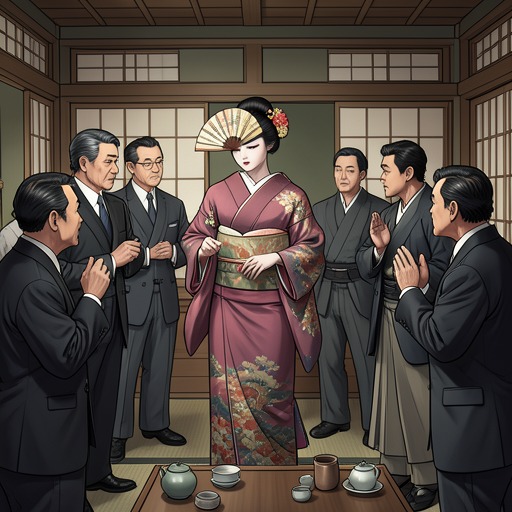
The household’s protection ends after Tottori is taken into custody in December 1942. A military policeman arrives amid allegations that the okiya has hoarded cotton, failed to surrender metal and rubber for the war effort, and misused ration tickets. The narrator acknowledges that the household committed these offenses, as did other okiya in Gion, but its unusually long survival and relative good fortune make it a target once its patron can no longer shield it.
The consequences arrive in stages. Within a week, the household loses stores of food and undergarments among other goods; supplies of tea that had once allowed the household to assist Mameha are no longer secure. Later, the neighborhood association confiscates ceramics and scrolls for sale on the gray market. Unlike the black market in rationed or illegal commodities, the gray market chiefly involves households selling treasured possessions for cash. In this case, however, the sales also serve as punishment, and the proceeds benefit others. Rationing thus extends beyond distributing shortages: enforcement reaches into household stores and turns valuable possessions into instruments of sanction.
Scarcity, Work, and Exchange
The system changes the meaning of everyday objects and exchanges. Under military restrictions, cosmetics and permanents are officially banned as luxuries, even as women in Gion retain some latitude because of their connections to men in power. Lavish gifts become rare, and Sayuri’s belongings amount to a few scrolls, inkstones, bowls, books, and magazines, plus a silver stereoscopic-photo viewer given to her by the Kabuki actor Onoe Yoegoro XVII. Such objects mark a narrowing of ordinary consumption and a growing separation between what is officially prohibited and what privilege can still secure.
Scarcity also reorganizes the household economy. The General covers Sayuri’s lessons, registration fee, and medical expenses, while his military procurement position brings supplies that other patrons could not provide. During the war, Mother grows richer by buying and selling other people’s heirlooms, including kimono Mr. Arashino asks her to recover so he may eventually buy them back. Meanwhile, Sayuri lives and works with the Arashino family, sewing parachutes and sleeping in their workshop; the family eats soybean dregs and a fried mixture of rice bran and wheat flour, with occasional potatoes, whale meat, seal sausage, or sardines. The sharp contrast between protected supply and improvised subsistence makes rationing a force that redistributes both material security and economic opportunity.
Collapse of the Wartime Order
When the government announces that the geisha districts will close, geisha are ordered to report to a registry office, and Sayuri wonders which of the men they know might save them from factory labor. The announcement marks a further contraction of the choices available to them: the patronage networks that had helped sustain Gion can no longer be assumed to preserve its institutions or livelihoods.
The consequences of wartime scarcity persist beyond the loss of particular goods. Two of Iwamura Electric’s four factories are destroyed, and Nobu gives Sayuri a piece of concrete rubble from the Osaka factory, explaining that the company may not survive the following years. The fragment turns industrial destruction into something physically held between the two characters, just as seized heirlooms and ration coupons make the wider system tangible. Across the novel, rationing reveals a wartime order in which access depends not only on need or rules but also on patronage, protection, and the capacity to convert possessions into survival.